- Home /
- SOP for PhD: Free Samples & Writing tips
SOP for PhD: Free Samples & Writing tips
Author
|13-03-2026

Starting your doctoral journey can feel challenging, but a strong SOP for PhD can significantly boost your chances. Your Statement of Purpose is more than just a document. It is your chance to show the admissions committee your research interest, analytical ability, time-management skills, and long-term academic goals.
Universities receive hundreds of applications with similar profiles, which is why documents like your SOP, LORs, and sample research papers play a crucial role in helping you stand out. Since clarity and precision are vital at the doctoral level, many applicants refine their drafts with the support of our expert SOP writers in India. The committee carefully reads your SOP to understand your potential as a scholar, your dedication to research, and how well you fit into their program.
That’s why drafting an impressive SOP for PhD requires time, clarity, and genuine intent. In this guide, we’ll walk you through how to write a compelling SOP, along with PhD SOP samples you can use as a reference while creating your own.
How to write an effective SOP for PhD?
To write an effective SOP for PhD, you must clearly express your research interests, academic preparation, motivation for pursuing a doctorate, and the long-term impact you aim to create through your research. A strong PhD SOP should demonstrate your research readiness, intellectual curiosity, and alignment with the university’s ongoing work.
Although the format of an SOP for PhD is similar to SOPs for other courses, a doctoral-level SOP must focus more on your research direction, academic background, and long-term research potential. Follow these steps to create a strong and impactful Statement of Purpose.
1. Talk About Yourself
Start your SOP by introducing yourself in a clear and concise way. Highlight your academic curiosity, how your interest in research developed, and what motivates you to pursue a PhD. Explain how your educational journey shaped your research direction and why you feel ready for advanced academic exploration.
2. Explain the “Why” Factor
Your SOP must clearly answer the core questions the committee looks for:
- Why are you interested in pursuing a PhD?
- Why have you chosen this specific field of specialization?
- Why do you want to study at this particular university?
- Why do you prefer this specific research group or supervisor?
This section shows the committee that your decision is purposeful and well thought out.
3. Show How You Fit the Program
Demonstrate why you are a good match for the program. Instead of praising faculty with generic statements, show genuine knowledge of the university’s research areas, publications, lab work, or ongoing projects. Explain how your interests align with their academic strengths and how you can contribute meaningfully.
4. Include Your Academic and Research Background
Give a clear overview of your educational journey—your Bachelor’s degree, Master’s coursework, and project or thesis work. Link this background to the research topic you want to pursue. Mention skills that strengthen your profile such as programming (Python, C++, MATLAB), computational techniques, laboratory experience, publications, conference papers, or research internships.
This helps the committee understand your readiness for doctoral-level research.
5. Be Careful While Emphasizing Work Experience
Work experience is helpful only if it is directly connected to your research interests. If your job roles involve research, analysis, coding, laboratory work, teaching or writing, you may highlight them. Avoid overemphasizing unrelated corporate roles, as PhD committees give preference to research-driven experience.
6. Address Past Issues Honestly
If you have backlogs, gaps, low grades, or career breaks, be transparent about them. Address these issues briefly and positively. Show how you overcame the setbacks and what you learned from them. Committees value resilience and maturity more than a perfect record.
7. State Your Career Goals Clearly
Your SOP must show where you see yourself after completing your PhD. Discuss your short-term goals (e.g., research assistantships, publications, postdoctoral plans) and long-term goals (e.g., academia, industry research, entrepreneurship, policy work). Clearly explaining your vision for the next 10–20 years shows the selection committee that you have a strong sense of direction.
8. Give a Strong, Confident Conclusion
End with a positive assurance of your commitment to research. Summarize your motivation, highlight your potential, and express how the program aligns with your academic journey. A strong conclusion leaves a lasting impression on the reader.
Sample SOP for PhD
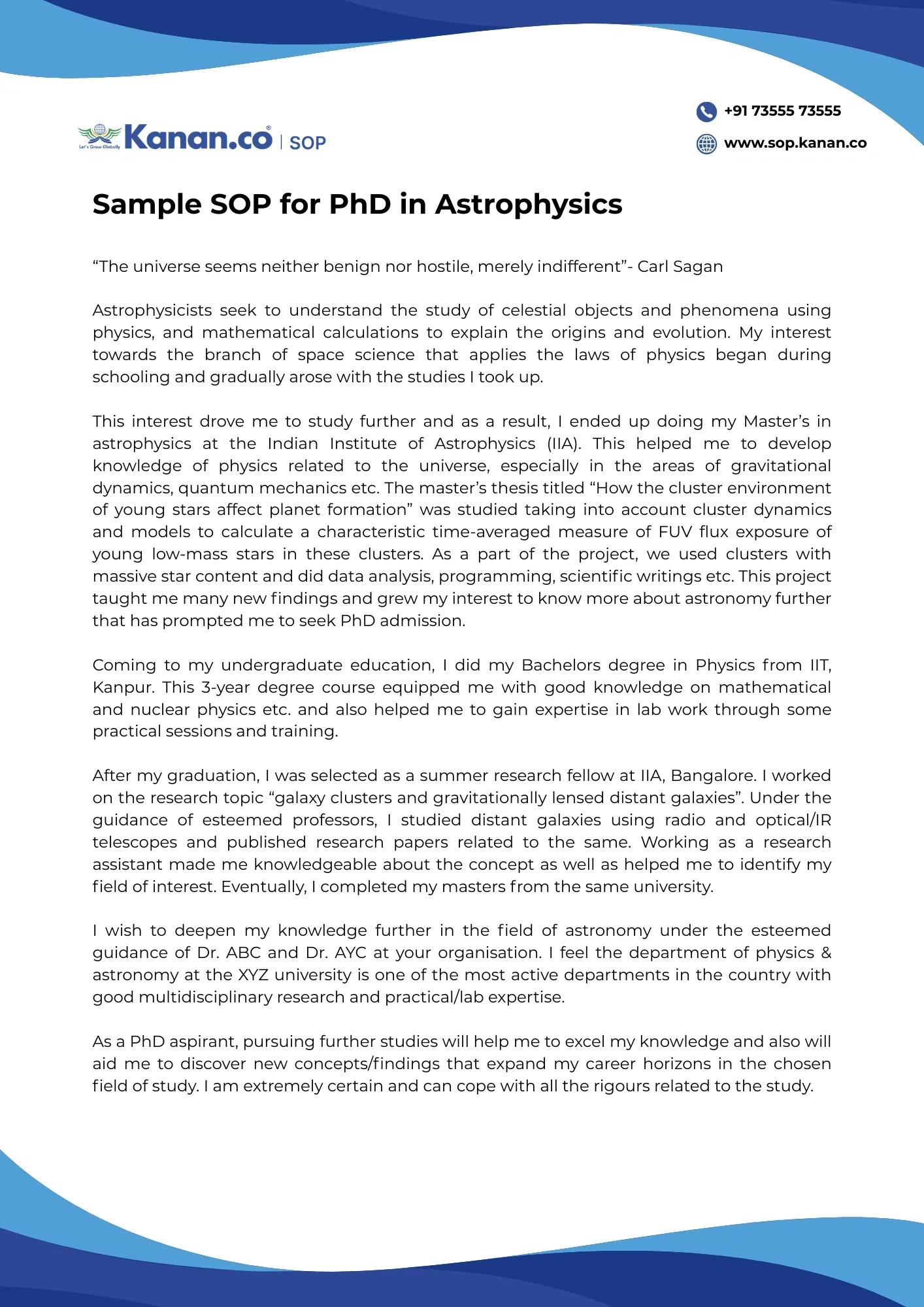
“The universe seems neither benign nor hostile, merely indifferent”- Carl Sagan
Astrophysicists seek to understand the study of celestial objects and phenomena using physics, and mathematical calculations to explain the origins and evolution. My interest towards the branch of space science that applies the laws of physics began during schooling and gradually arose with the studies I took up.
This interest drove me to study further and as a result, I ended up doing my Master’s in astrophysics at the Indian Institute of Astrophysics (IIA). This helped me to develop knowledge of physics related to the universe, especially in the areas of gravitational dynamics, quantum mechanics etc. The master’s thesis titled “How the cluster environment of young stars affect planet formation” was studied taking into account cluster dynamics and models to calculate a characteristic time-averaged measure of FUV flux exposure of young low-mass stars in these clusters. As a part of the project, we used clusters with massive star content and did data analysis, programming, scientific writings etc. This project taught me many new findings and grew my interest to know more about astronomy further that has prompted me to seek PhD admission.
Coming to my undergraduate education, I did my Bachelors degree in Physics from IIT, Kanpur. This 3-year degree course equipped me with good knowledge on mathematical and nuclear physics etc. and also helped me to gain expertise in lab work through some practical sessions and training.
After my graduation, I was selected as a summer research fellow at IIA, Bangalore. I worked on the research topic “galaxy clusters and gravitationally lensed distant galaxies”. Under the guidance of esteemed professors, I studied distant galaxies using radio and optical/IR telescopes and published research papers related to the same. Working as a research assistant made me knowledgeable about the concept as well as helped me to identify my field of interest. Eventually, I completed my masters from the same university.
I wish to deepen my knowledge further in the field of astronomy under the esteemed guidance of Dr. ABC and Dr. AYC at your organisation. I feel the department of physics & astronomy at the XYZ university is one of the most active departments in the country with good multidisciplinary research and practical/lab expertise.
As a PhD aspirant, pursuing further studies will help me to excel my knowledge and also will aid me to discover new concepts/findings that expand my career horizons in the chosen field of study. I am extremely certain and can cope with all the rigours related to the study.
Statement of Purpose for PhD sample
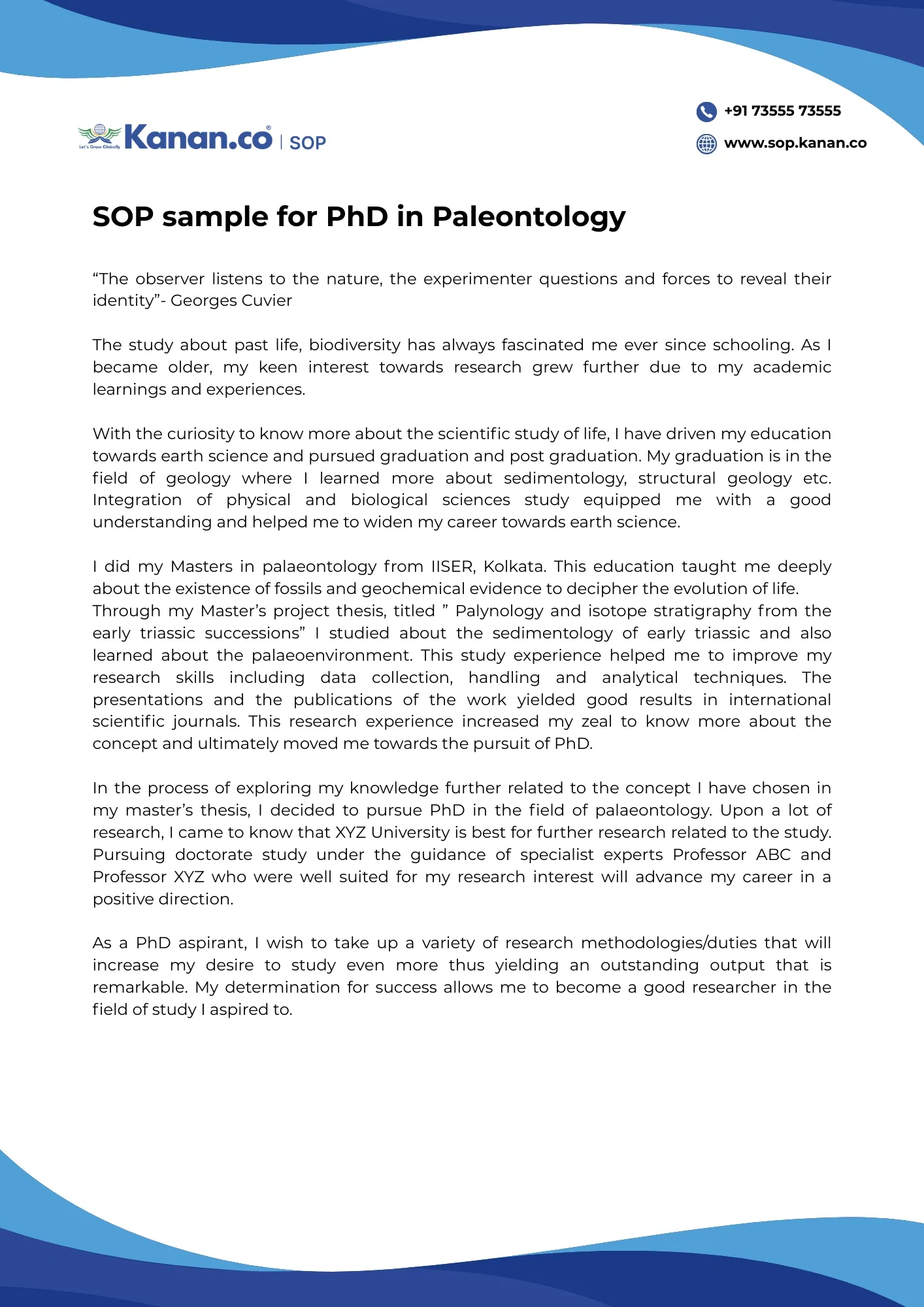
“The observer listens to the nature, the experimenter questions and forces to reveal their identity”- Georges Cuvier
The study about past life, biodiversity has always fascinated me ever since schooling. As I became older, my keen interest towards research grew further due to my academic learnings and experiences.
With the curiosity to know more about the scientific study of life, I have driven my education towards earth science and pursued graduation and post graduation. My graduation is in the field of geology where I learned more about sedimentology, structural geology etc. Integration of physical and biological sciences study equipped me with a good understanding and helped me to widen my career towards earth science.
I did my Masters in palaeontology from IISER, Kolkata. This education taught me deeply about the existence of fossils and geochemical evidence to decipher the evolution of life.
Through my Master’s project thesis, titled ” Palynology and isotope stratigraphy from the early triassic successions” I studied about the sedimentology of early triassic and also learned about the palaeoenvironment. This study experience helped me to improve my research skills including data collection, handling and analytical techniques. The presentations and the publications of the work yielded good results in international scientific journals. This research experience increased my zeal to know more about the concept and ultimately moved me towards the pursuit of PhD.
In the process of exploring my knowledge further related to the concept I have chosen in my master’s thesis, I decided to pursue PhD in the field of palaeontology. Upon a lot of research, I came to know that XYZ University is best for further research related to the study. Pursuing doctorate study under the guidance of specialist experts Professor ABC and Professor XYZ who were well suited for my research interest will advance my career in a positive direction.
As a PhD aspirant, I wish to take up a variety of research methodologies/duties that will increase my desire to study even more thus yielding an outstanding output that is remarkable. My determination for success allows me to become a good researcher in the field of study I aspired to.
Statement of Purpose for PhD sample pdf
Soft Skills to be included in your SOP for PhD
As a PhD aspirant, highlighting the soft skills in your SOP will raise the chances of getting admission. Do focus the skills like
- Problem solving
- Creativity
- Analytical thinking
- Communication skills
- Integrity
- Teamwork
- Passion for success
- And willingness to learn
Check more Course-wise PhD SOP Samples:
- Sample SOP for Information Technology
- PhD SOP Sample in Game Art and Design
- Sample SOP for Biotechnology
Motivation and Recommendation Letters for PhD Programs
Some PhD programs require applicants to submit a Motivation Letter or a Letter of Recommendation (LOR) along with the SOP. Although both documents support your application, they serve different purposes.
A Motivation Letter is written by you and is usually addressed directly to the department or the Professor under whom you wish to pursue your research. It highlights your motivation, research intent, academic background, and reasons for seeking supervision from that particular faculty member. While it shares similarities with an SOP, it is more personal and professor-focused, not university-focused.
On the other hand, a Letter of Recommendation is written by a Professor, Project Supervisor, HOD, or employer who is familiar with your academic performance or research work. It evaluates your abilities, strengths, research potential, teamwork, and suitability for a PhD program. For detailed steps on writing a strong LOR, please refer to the LOR Guidelines.
Human-Sounding SOP Writing Tips to Avoid AI Detection
1. Write in Your Natural Tone
AI tools produce uniform sentences. Add small personal quirks, natural phrasing, and your usual writing rhythm to make the content sound authentically human.
2. Add Real Experiences & Specific Details
Mention real events, dates, projects, names of labs, or tools you used. AI-generated text often stays generic, so specifics immediately boost authenticity.
3. Vary Sentence Lengths
Mix short and long sentences. Irregular patterns are a strong human-writing signal and help bypass AI-detection tools easily.
4. Include Genuine Reflections
Share what you felt, learned, or realised during a project. Human reflection is difficult for AI tools to fake, improving originality.
5. Use Mild Imperfections
A few naturally imperfect sentences or slightly informal transitions make the SOP look real and reduce AI-generated patterns.
6. Edit Instead of Fully Generating
Use AI only for structure or brainstorming—then write the core story yourself. This keeps the content human while still improving clarity.
7. Add Field-Specific Vocabulary
Use technical terms from your research area. AI detection tools flag content that stays too broad or too polished.
8. Always Rewrite AI Output
Never paste raw AI text. Rewrite it in your own voice, add depth, and personalise examples to maintain uniqueness and bypass AI flags.
Top Universities admission criteria for a PhD course
Though the guidelines for the admission to PhD remain the same, the university provides its own SOP structure. Let’s have a look at the admission criteria of a few universities.
Stanford University, USA
Guidelines to be followed for submitting SOP for PhD to Stanford University are as follows:
- SOP should be typed, single spaced and 1-2 pages long.
- Describe the reason for applying to the particular program and your preparation for this field of study.
- Explain how this program perfectly fits you and talk about your future career plans
- Speak about your academic backgrounds and interests.
Harvard University, USA
The points to be considered while writing a statement of purpose to Harvard University are:
- SOP should maintain a word limit of 1000-1500.
- Describe in detail about professional experience and connect it with the reason that prepares you to pursue this advanced study.
- Tell the challenges you seek to address as a part of your research in this field of study
- Explain about your long-term and short-term goals.
University of Toronto, Canada
- SOP should be a maximum of 1500 words, double-spaced
- Your statement should be in an essay format explaining the outline of the research you plan to undertake in PhD.
- Explain about your academic/professional background and tell about scholars who inspired you in this field of study
- Tell how your research contributions create a way to intellectual diversity.
- Your research statement should be plagiarism free.
Other links:
Summary
Writing an SOP for PhD is not just about listing achievements, it’s about telling your story with honesty and confidence. Keep your academic details and research work genuine, stay away from plagiarism, and let your true motivation shine through. Use the tips and sample SOPs in this guide to shape a document that reflects you and makes the committee remember your application.
FAQs on SOP for PhD
1. How long should an SOP for PhD be?
The statement of purpose for PhD should range between 500 to 1000 words unless specified by the university. It should be one to two pages long and has to convey the information to the point in a precise way.
2. What is the statement of purpose (SOP) for PhD?
SOP for PhD is a document that explains why you are eligible/qualified for a PhD program. It includes a brief summary about your academic and professional background. Also talks about the past research experience you had related to the field of study you are applying for.
3. Do research experience and paper publications matter for the selection in a PhD programme?
Yes, Having prior experience in research and paper publications will be an added advantage to your application over the others. Do mention these details in your SOP if you have done any paper publications or worked as a research fellow.
4. How do you write a PhD SOP?
- Make a proper statement for yourself
- Answer the "Why" question
- Explain your Research interest
- Talk about Academic and Research background
- Be straight-forward in addressing the previous issues
- Explain the reasons to join this specific program/course and university
- Highlight some soft skills you possess
- Mention your short-term and long-term career goals
5. What are the mistakes you should avoid in an SOP for PhD?
Common mistakes you should avoid while writing SOP for PhD is dull introduction, introducing your name etc. Avoid exceeding the prescribed word limit, using informal style of writing, and talking about your family history or financial situation. Do not write your SOP at the last minute and don’t praise too much about the institution or faculty.
6. Why are PhD applicants rejected?
The most common cause for the application to be rejected is lack of research experience. It doesn’t matter how many years of experience you had but what matters more is if you have the potential ability to conduct research/study in that particular field.
7. What makes an SOP for a PhD different from an SOP for a Master’s?
A PhD SOP focuses heavily on research depth, proposed research ideas, and alignment with a specific professor’s work. A Master’s SOP highlights academic interest, career goals, and learning objectives. In short, Master's SOP is about learning, while PhD SOP is about contributing new knowledge.
8. What are the common mistakes to avoid in a PhD SOP?
Common mistakes include being too general about research interests, adding unnecessary personal stories, and failing to link your goals with a professor’s research. Many students also make claims without evidence or write an SOP that sounds like a Master’s application. A PhD SOP must be specific, technical, and research-focused.
9. How do I tailor my SOP for a specific professor?
Read the professor’s recent papers and identify how your background connects to their ongoing work. Mention the professor professionally, explain your research alignment, and show how your proposed ideas fit into their current projects. Keep it specific and demonstrate genuine understanding of their research direction.
About Author Amrita Ganguly
Amrita Ganguly is a senior SOP writer at Kanan.co with extensive experience in content strategy and academic storytelling for international admissions.
More Articles Posted By
Your Dream University Starts With the Right SOP!